
It’s that time of year again! Spring break has come and gone and we simultaneously wish for summer to get here ASAP and for the school days to go just a little bit slower so we can cover everything before the last day of school.
We’re also tired. Teacher tired. There’s nothing quite like it and anyone who tells you otherwise probably has never spent a day wrangling students or trying to effectively engage students in online classes.
Spring is a perfect time to refresh and re-energize and to use every tool in our toolbox to ensure that our lessons are engaging and effective. Our students are tired, too, and this fact should not be overlooked or underestimated as we plan for the big push to summer. We need to offer them every opportunity to bring their best selves to the classroom.
When we think of ways to make lessons more engaging, we often turn to gamifying the lessons or drumming up other ways to make the learning fun. After all, who doesn’t want to have fun, especially in school? There’s nothing wrong with this way of thinking, but it’s not enough. We need to always be on the lookout for strategies that help our students stay focused on the task at hand so they can get the most out of those lessons we’ve worked so hard to plan.
Translanguaging might just be one of my favorite ways to accomplish this. It’s a tool that, when used correctly, affords all students access to all lessons and allows for everyone to participate fully in every activity. When students are empowered to actively contribute to learning activities, there’s a greater likelihood they will find those activities worthy of their time and effort. What could be better than that, especially when spring fever has hit our campuses!?
If you’re not sure what translanguaging is, I’ve adapted a simple definition & description from one of the world’s translanguaging gurus, Dr. Ofelia Garcia. Though her work includes translanguaging as both pedagogy and as a mechanism for social justice, the following highlights the student and teacher experience in the classroom.
Translanguaging is when multilingual students use all of the languages at their disposal so they can engage fully in all learning activities. Teachers make intentional choices about when it’s appropriate to ask students to use multiple languages so they can access content and process ideas more readily.
Dr. Garcia’s work in this area is beyond impressive. If you have yet to explore her contributions to our field, she offers an intro to translanguaging in this video.
Fears & Frustrations
At the mention of leveraging students’ languages for learning, I frequently encounter teachers and school leaders who love the concept of translanguaging but who may have fears and frustrations when it comes to languages other than English being spoken in their classrooms.
But I thought our students were supposed to be learning English.
My students have to take an exam in English. I don’t have time for them to practice in another language.
I don’t speak their languages. How do I know they’re not gossiping or talking about video games when they’re supposed to be learning?
These concerns are understandable, but let’s take a closer look at the simplified definition of translanguaging, specifically, this phrase … teachers make intentional choices about when it’s appropriate.
We make intentional choices about our lesson plans all the time. We carefully contemplate how to activate students’ background knowledge, how to group them for a particular activity, how to best deliver the content, how to check to see if they’re understanding, and even how we want to close the lesson. That’s what good teachers do. Our expertise plays out in the countless choices we make about how to teach a concept or how to best facilitate student engagement. These choices, based on our own knowledge of pedagogy and child development, are the basis for effective lesson planning and make the difference between a ho-hum lesson where students are easily distracted or off-task and an engaging lesson that flows like water and captivates our students’ attention.
The same can be said for our intentional use of translanguaging in the classroom. When we think of it as just one tool among thousands in our teacher toolbox, we can use it wisely and in ways that help students learn. Our MLLs are already calling upon their knowledge of multiple languages when they read and listen, we just don’t always see it because it’s happening in their minds as they use their receptive language skills. Their linguistic assets are always there, but hidden below the surface. Sadly, they are sometimes admonished to keep this part of their thinking and identity under wraps in the interest of ‘learning English.’ MLLs find themselves in the situation of having to learn in a language in which they have not yet gained full proficiency. What a lost opportunity for us and for them when we don’t encourage them to use all of the language skills at their disposal.
I don’t know about you, but I’d feel pretty disadvantaged, and possibly even demoralized, if I were compelled to learn about organic chemistry, let’s say, in a classroom where the teacher and my peers were all speaking Mandarin, a language in which I have a very limited vocabulary, sense of grammar and sentence structure. Add spring fever to this and I might check out completely. If I could use my English skills, however, to process the new ideas presented by my teacher, I’d understand more about the chemistry lesson that day and would likely feel better about the challenge of learning in Mandarin. My affective filter would come down and my understanding of chemistry and my capacity to participate in the lesson would go up. I’d be more motivated to participate and poised to reap the benefits of productive struggle.
Getting Started
Rather than simply relying on our MLLs to use multiple languages in a passive way as they might when listening or reading, let’s think about deliberately bringing their linguistic knowledge to the surface in ways that are active and engaging. The first step in deciding whether or not to use translanguaging as a learning tool is to think about your priorities for a particular activity. Is the priority 1) for students to produce something in English, like sentences, a story, essay, or oral report? Or, 2) to engage students fully and to help them process, think, and learn? If the answer is 2, translanguaging is an appropriate tool that can be leveraged by you and your students.
Another way to think about it is in terms of language vs. communication. Is the goal in a particular lesson for the students to learn English, or is the goal to get them to be more communicative so they can participate to a greater degree in our learning activities? If communication and engagement are the goals, translanguaging can help students get there.
Translanguaging is HOT
Experience and research tells us that we should hold high expectations for our MLLs. If we don’t we risk watering down or oversimplifying lessons in such a way that it prevents students from developing age-appropriate skills and understandings. Over time, the effect can be devastating, resulting in students advancing through many grades without having had equal access to the curriculum. For more on this and related topics, I highly recommend Zaretta Hammond’s Book, Culturally Responsive Teaching and the Brain: Promoting Authentic Engagement and Rigor Among Culturally and Linguistically Diverse Students (2015).
An important part of holding high expectations for MLLs is making sure we are asking them to employ their higher order thinking skills, or HOTS, as opposed to overly relying on low order learning activities like rote memorization or those that involve basic recall. Higher order thinking (HOT) includes activities that compel students to create, analyze, synthesize, and evaluate. In other words, they’re taking what they know, and applying it to new situations in complex and creative ways.
When MLLs have yet to develop the language skills needed to participate in HOT activities this can be highly frustrating for them and their teachers. These students have likely participated in a range of HOT tasks in their home language, or L1, but have difficulty conveying their knowledge to peers and teachers due to the fact that their L2, or target language, is a work in progress. With just a few translanguaging moves, as I like to call them, students who are developing academic English are able to effectively leverage what they know in their L1 so that their understanding of concepts in L2 is enhanced and age-appropriate thinking skills are developed. For each of the activities below, I started by organizing students into groups of students who share the same home language. I call these L1 groups.
When I have a student whose L1 is not shared by anyone else in the class, I partner with that student and encourage them to use their home language even if I can’t understand everything they are saying or writing. I like to keep a small, portable whiteboard on hand to jot key terms in English or to make quick illustrations as needed.
Whether you already employ translanguaging strategies in the classroom or are new to the idea, I hope these simple activities can make their way into your spring lesson plans so that every student can sustain the momentum they need to make a strong finish to the school year.
It’s important to model and give clear directions and expectations for each task. When students know when and why to use L1, it makes it much less likely that they will go off-task or use class time for socializing. As well, monitoring partner and group work by moving from table to table as students complete a task helps to keep them focused. If teaching virtually, students can be organized into breakout rooms that are monitored by the teacher.
Translanguaging Moves
Annotation Conversation
Annotation is a great way to have students interact with text and/or graphics, especially when there’s a purpose for the annotations. Some common reasons we ask students to annotate are to identify examples, to note text features, to interpret a diagram, to highlight evidence, to record observations, or simply to jot questions in the margins.
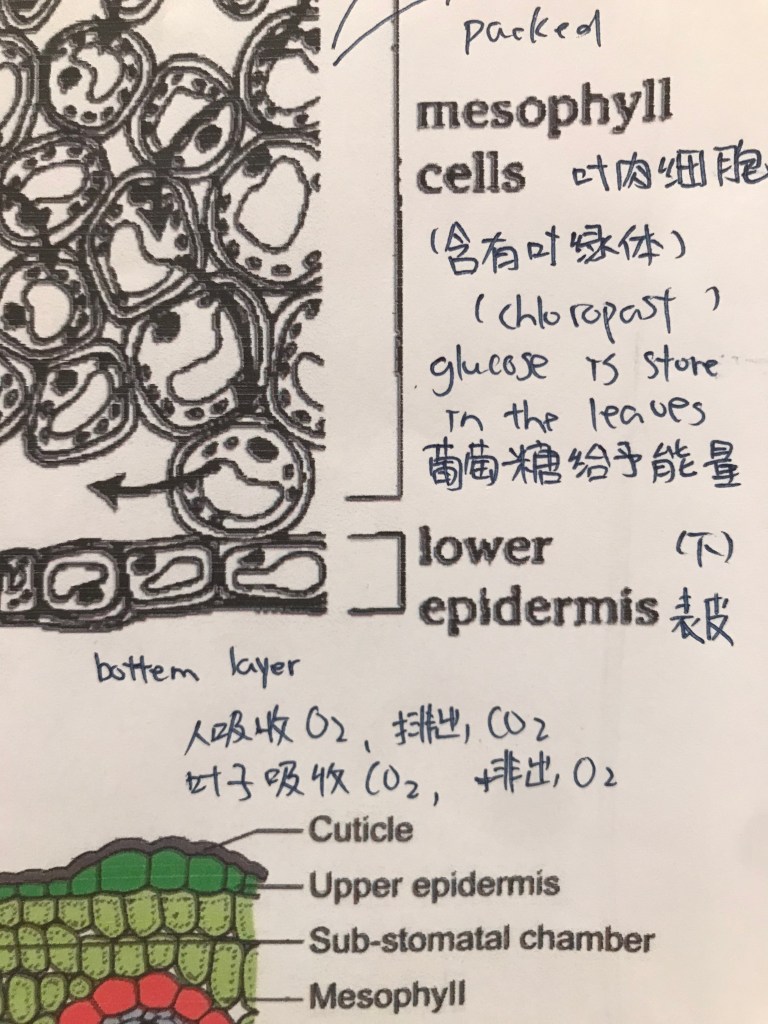
We can easily turn annotating into a translanguaging move by organizing the class into L1 groups. Encourage students to discuss what they’d like to annotate using any language(s) of choice. Students can then take turns writing their annotations. Again, this can be done in any language. When completed, allow time for students to look up any terms they need to translate into English and note these translations in the margins.
In this instance, students were given a blank diagram from their science class and instructed to discuss what they remembered from last week’s lesson and jot their thinking on the diagram and in the margins. As you can see, they used a combination of Mandarin and English to complete the task.

Benefits
- Lightens the language load
- Keeps the focus on thinking and analyzing, rather than on correct use of English
- Activates prior knowledge
Check Your Answer
Next time you want students to self-correct an assignment, try grouping students who share the same L1 together. Partners or groups of 3 are ideal. Ask them to check their answers for accuracy against a teacher-prepared answer key. Then, and this is the vital translanguaging component, admonish them to use their L1 as needed to clarify why they missed certain items and how to arrive at the correct answer. They can then go back later and add any notes they wish in English with the help of a dictionary or translation app. By using L1 when clarifying understanding, MLLs can use the full range of their vocabulary and knowledge to solidify new learning in L2.

Benefits
- Activates prior knowledge in L1
- Encourages analysis and metacognition
- Provides multiple access points for clarifying information gaps
List-Group-Label
This is a vocabulary and comprehension strategy that I initially used in an elementary classroom. If you’re not familiar with the activity, you may wish to view this video by Reading Rockets. I love how the activity promotes interaction and critical thinking, so I adapted it for use in my high school English Language Development (ELD) classroom and turned it into a translanguaging activity. Rather than have the students brainstorm key words as in the video, I list the academic words I want them to use on the board or chart paper.
First, organize students into pairs or small groups who share the same L1 and provide them slips of paper or note cards. Students then work together to write key terms on slips of paper in L2. For virtual learning, it works well to prepare these digitally in advance so that students can move them around on a shared document. Then, direct students to use L1 and/or L2 to determine logical categories for the words and an appropriate label for each category. Students then share their reasoning and justification aloud in L2. Emergent bilinguals may benefit from sentence frames like this one:
We put these words into a group labeled________because___________.

Benefits
- Facilitates communication of higher order thinking
- Promotes grade-level maintenance of L1
- Develops analysis and metacognition
- Contextualizes academic vocabulary
To extend this activity even further, take a photo of each group’s completed task so that the key words and labels are visible. Print one copy of each to use for the next class period. When the class meets again, give each group a photo of another group’s work from the previous day and encourage them to identify similarities and differences in how they would have organized and labeled the same words. Again, encourage use of L1 to facilitate deep thinking. This provides another opportunity for students to clarify ideas, to use academic vocabulary in context, and to hear how peers use these terms.

No matter which grade or subject you teach, there’s a place for translanguaging. When MLLs are invited to bring their full language repertoires to school and use them for learning, they’re making use of one of their greatest assets: the gift of being multilingual. The ideas outlined here are simple yet powerful and I hope you’ll give them a try. When you do, I’d love to hear how it goes.
References
“Classroom Strategy: List-Group-Label.” YouTube, Reading Rockets, 1 July 2011, https://youtu.be/K731qicwYcY.
Hammond, Zaretta. Culturally Responsive Teaching and The Brain: Promoting Authentic Engagement and Rigor Among Culturally and Linguistically Diverse Students. SAGE Publications, 2015.
López, Rafael, and Pat Mora. “Affective filter | Colorín Colorado.” Colorin Colorado, https://www.colorincolorado.org/glossary/affective-filter.
Napper, Kristine. “Education Equity and the Necessity of Having High Expectations.” Edutopia, 26 June 2019, https://www.edutopia.org/article/necessity-having-high-expectations.
Sriram, Rishi, and Richard Allen. “The Neuroscience Behind Productive Struggle.” Edutopia, 13 April 2020, https://www.edutopia.org/article/neuroscience-behind-productive-struggle.
Watson, Sue. “Are High-Order Thinking Skills (HOTS) in Education?” ThoughtCo, 25 February 2019, http://www.thoughtco.com/higher-order-thinking-skills-hots-education-3111297.
“What is Translanguaging?” YouTube. CUNY-NYSIEB Online Series: Introduction to the Translanguaging Guide.10 November 2015. http://www.youtube.com/watch/?v=veylQoGrySg.
 ALL in Education
I really enjoyed this. Your explanation was clear and straight to the point. Thank you for sharing such practical and useful information. Looking forward to your next post!
LikeLiked by 1 person