By now you’ve likely heard of the elevator pitch, a short speech designed by professionals to share their credentials and skills with people who may not be familiar with their areas of expertise. They are often used during job interviews or at networking events as an efficient way to highlight our professional backgrounds. A speech of this sort allows us to offer a quick synopsis of our background, experience, and goals in the amount of time it would take to share an elevator ride with someone. In fact, good elevator pitches are no longer than 60 seconds. This makes it easier for listeners to pay attention and it forces the speaker to get right to the point.
There are other advantages, too. Delivering elevator pitches gives us opportunities to practice speaking with more clarity and precision, and it also boosts our self-confidence.
When I first learned about the utility of developing an elevator pitch for myself, my mind immediately went to myl English learners. They needed opportunities to practice articulating their ideas, and they sure could benefit from increased confidence in their abilities. So, I took the idea of the elevator pitch, which is very common in the corporate world, and used it as the format for my high school students to introduce themselves to a partner during the first week of school. If you’re interested in trying this out, consider whether students might benefit from a paragraph frame such as this one:
Hello, I’m_______and I’m in ___ grade. I’ve attended school here since_____and my favorite subject is__________. I enjoy____________. One thing I’m proud of is______. This school year, I hope to________.
My students loved this activity for a few reasons: 1) the required length was short, 2) they only had to speak to a partner, not the whole class, and 3) they got to talk about things that were important to them personally. The elevator pitch was a non-threatening, low-stakes activity with a very low affective filter.
Well, the elevator pitch introductions were just the beginning for me. When particular activities like this one are working in my classroom, I try to dissect what the students and I have done with an eye toward adapting the activity for use in other areas. I am particularly interested in strategies and activities that promote interaction, and this one definitely fills that bill. This is how I ended up with Pitch the Plan, a short speech designed for students to share their prewriting ideas with their peers.
For most of my career, I’ve found it helpful to have students of any age develop a plan for their writing and to talk to me or a partner before they actually sit down to write. These simple practices promote writing fluency and help students think about the structure of their writing more intentionally. So, I merged these activities with the concept of an elevator pitch and developed Pitch the Plan as a regular part of my writing program.
Here’s how it works in my classroom.
1 – Whiteboards or chart paper to co-brainstorm
Students work with 1 or 2 partners to brainstorm, plan and record their notes on a portable whiteboard. I keep various sizes and types of whiteboards on hand: small ones for individuals, some a bit larger for small-group and partner work, as well as a couple of tables with an erasable surface. If your students don’t have access to these you can use chart paper. They are making plans for their individual writing tasks, but I find that plans are more detailed and complete when students have bounce their ideas off of a partner or two first. This gives students an opportunity to collaborate using content-based vocabulary and includes the important element of embedding writing and speaking into lessons.

2 – Developing a plan
As students brainstorm, they are encouraged to develop a plan for their writing as they talk. The plan is intended to provide a preliminary road map for the student writers in the interest of bringing structure and focus to their writing. While a variety of structural models and graphic organizers are offered (for example, a T-chart, a bullet-point outline, etc.), students are encouraged to organize their writing in a way that suits the particular task, audience, and/or purpose.
Students sketch and/or make notes on their whiteboards or chart paper to prepare to share their ideas aloud with other students. It’s helpful, at this point, to have them do a short practice session with a partner.
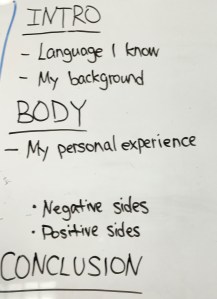
3 – The Gallery Walk
For this part, I set the room up as a Gallery Walk, with the student whiteboards/chart papers propped up for display at various “stations” around the room. We travel as a class to each station.
As we stop at each board, the writer who drafted the plan steps forward to pitch it to the rest of us with the help of the visual aid they created. I act as the timekeeper. While a typical elevator pitch is 60 seconds or less, I find a 2-minute time limit works best for this activity; students still have to be concise but aren’t compelled to speak too quickly.

After we’ve rotated through all the stations, I close with a few guided questions such as these:
Now that you’ve seen other plans and done some more thinking, is there anything you might change about your plan?
Is there a plan that you thought was particularly well done? What is it about that plan that you liked?
I also emphasize that planning ahead helps us organize our ideas effectively, but that good writers don’t necessarily stick to their original plans. Authors may decide to add, delete, or move ideas around as they see fit and as their writing develops.
Give students a few minutes to revisit their plans. I find it most helpful for students to do this independently, and to note any modifications they’d like to make to their original plan now that they’ve had some time to discuss, view peer models, and reflect.
Let’s recap the many benefits of using Pitch the Plan in the classroom:
- Whiteboards/chart paper are informal/not assessed for students but provide great formative data for teachers
- Establishes the act of writing as a fluid, creative process whether writing narratives or expository pieces
- Creates multiple interaction points/opportunities for oral language development
- Promotes generation of multiple ideas
- Encourages use of all language domains
- Develops the habit of intentionally organizing writing for the greatest impact on readers
- Provides students with multiple models for organizing their own writing
- Allows students to practice oral presentation skills in front of a familiar audience
- Builds self-confidence
While Pitch the Plan is great for larger writing assignments or projects, the basic concept is easily modified for other uses. For example, if students are writing a short paragraph, I might have them take a moment to plan their main points on a sticky note, then meet in groups of 3 to pitch their paragraph plans to each other before allowing a few minutes for verbal peer feedback.
I hope you find a way to incorporate Pitch the Plan as part of your students’ writing or project work. If you have questions along the way or just want to share how you plan to use it in your classroom, please feel free to connect here or on Twitter @alycia_owen.
 ALL in Education