JOT. It’s what we do when we want to write a quick note to ourselves so that we don’t forget something important.
As an acronym, it stands for Just One Thing.
Rick Hanson, psychologist, author, and Senior Fellow at the Greater Good Science Center at UC Berkeley, has even turned JOT into a newsletter. Each month, subscribers receive a simple practice, or ‘Just One Thing’ designed to expand one’s wisdom, joy, and happiness. These JOTs are not elaborate plans for well-being and they aren’t necessarily goals unless you want them to be. The newsletter is simply a series of quick suggestions to put readers on the path to a happier, healthier existence.
As we start a new school year, let’s JOT for ourselves. Think about one small shift or practice that would foster happiness, well-being, or a positive outlook. Do this once for your personal life and once for your professional life. It doesn’t take big shifts in practice to make amazing gains, so small and simple is good. For example, I might choose to drink more water for my personal health. In my professional life, I might commit to eating lunch outside of my classroom rather than working straight through the day. Now, you try it! If you need some ideas to get you started, you can refer to last month’s post.
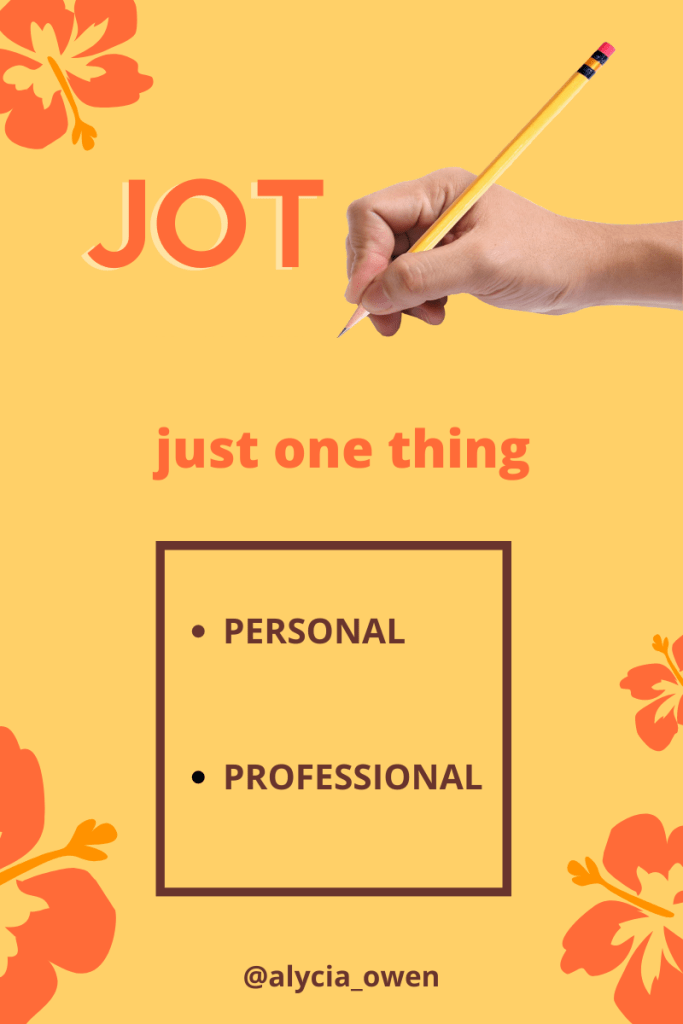
That was easy, wasn’t it? You now have two strategies that, despite being simple, have the power to create a big impact on your health and happiness. If you want to turn your JOTs into goals, that’s easy, too. Just think about adding in a few more specifics so that your JOTS become SMART goals. SMART goals help us stay on track while moving toward our goals and are:
S – Specific. You’ve already done this part with your JOT.
M – Measurable. How will you know if your goal’s been accomplished?
A – Achievable. Is it realistic?
R – Relevant. Does it serve me in the context of my current circumstances?
T – Time-bound. When do I want to achieve my goal?
Using my professional JOT about eating lunch away from my desk, here’s how it might look when expressed as a SMART goal:
I will go to the staff room or outdoor tables to eat lunch at least 3 days a week for the first month of the school year.
As with any goals, we can then stop at the end of our self-imposed timeline and re-evaluate. Was I able to achieve the goal? Did it improve my life in any way? Do I want to continue this practice? Do I need to revise my goal? Set a new one?
Whether you just quickly identify your JOTs or turn them into SMART goals is up to you. What matters most is that you start the school year strong by prioritizing ongoing self-care. Make it a habit to prioritize your physical and mental health so that you can feel your best and give your best to your students, friends, and family.
Teaching is arguably one of the most demanding professions on the planet and I’m rooting for you as this new school year takes shape. Good luck and best wishes! May you and your students thrive in the months ahead and make lots of wonderful memories along the way.

Resources
Asana. “Set-and Achieve-Smart-Er Goals.” Asana, https://asana.com/resources/smart-goals.
“Just One Thing Free Newsletter.” Dr. Rick Hanson, 17 Sept. 2020, https://www.rickhanson.net/writings/just-one-thing/.
 ALL in Education